
Koneksa Services
Built for execution and inspection readiness, our clinical data management services embed quality and compliance throughout the trial to keep data reliable, interpretable, and decision-ready.
Data Management That Goes Beyond Collection and Cleaning

Clinical data management is one of the most execution-critical functions in a clinical trial, directly influencing data reliability, regulatory confidence, and the interpretability of study results. When data management is treated as a downstream or episodic task, issues surface late, variability compounds, and confidence erodes at the moments it matters most.
Koneksa delivers clinical data management as an execution-time discipline, embedding quality controls, compliance, and automated oversight directly into data workflows. This approach enables earlier risk detection, protects signal integrity, and supports more consistent data interpretation through database lock, submission, and inspection.
Experienced Across Leading EDC Environments


and more…
Integrated Clinical Data Management Capabilities
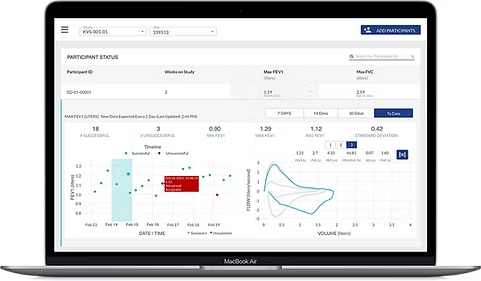
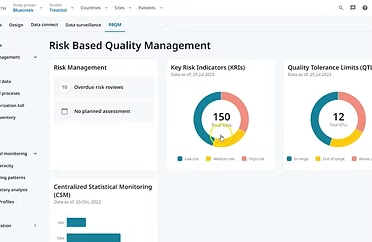
RBQM Dashboard with Medidata
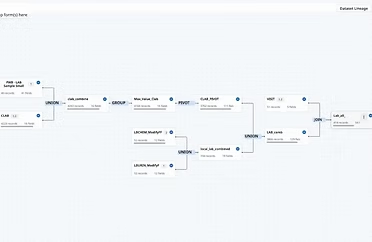
Custom Dataset with Medidata
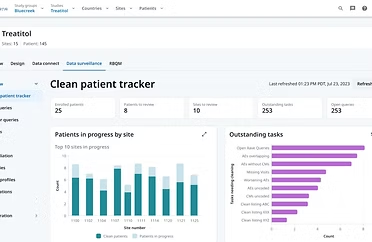
Participant Tracker Data from Medidata

Clinical Database Build and Management
Clinical databases are designed and built in adherence to Clinical Data Interchange Standards Consortium (CDISC) and Clinical Data Acquisition Standards Harmonization (CDASH) standards, and then managed from protocol and case report forms (CRFs) through the Study Data Tabulation Model (SDTM), ensuring analysis and submission requirements are addressed from the outset rather than retrofitted later.
Deep expertise across Medidata Rave and additional electronic data capture (EDC) platforms supports Phase I–IV studies and complex trial designs without compromising execution speed or data integrity.

Data Reconciliation and Cross-Domain Consistency
Automated analytics continuously reconcile data across domains to identify discrepancies, missing information, and inconsistencies during execution rather than being end-loaded or deferred until just before database lock.
This approach reduces manual effort, improves traceability, and strengthens inspection readiness throughout the study lifecycle.

Embedded Risk-Based Quality Management
Risk-based quality management (RBQM) is embedded directly into data workflows, with continuous monitoring of quality tolerance limits to identify emerging risks early.
Analytics flag anomalous patterns, including atypical visit timing, enabling proactive intervention aligned with ICH E6(R2/R3) expectations.

Reporting Behavior and Data Quality Oversight
Visualization and analytics highlight reporting patterns across adverse events, concomitant medications, and medical history at the site, country, and regional level, rather than within individual data domains alone.
This enables targeted oversight and remediation, improving consistency, credibility, and interpretability of both clinical and safety data.

Inspection-Ready
by Design
Inspection readiness is built into data management from study start, with traceability, auditability, and documentation embedded directly into execution workflows.
Validated systems and standardized processes compliant with 21 CFR Part 11 support integrations, mid-study updates, reporting, and efficient study close-out without compromising execution speed or data integrity.
Beyond Database Lock

 Koneksa data management is designed to protect measurement intent throughout the trial, not just deliver compliant datasets at database lock. By embedding quality, automation, and regulatory rigor into execution, we reduce interpretability risk before it becomes irreversible.
 This execution-first model integrates data management with biostatistics and statistical programming, ensuring data is not only compliant, but coherent, interpretable, and ready to support confident clinical decisions.