5 Questions to Ask Before Choosing a Digital Biomarkers Partner
- Koneksa Health

- Mar 27
- 6 min read
Introduction
The adoption of digital biomarkers in clinical trials is accelerating rapidly, driven by wearable sensors, decentralized trial models, and the demand for continuous patient monitoring. As sponsors increasingly explore digital measurement approaches, selecting the right partner has become a critical strategic decision.
However, a key challenge remains. While it is now easier than ever to collect large volumes of digital health data, extracting clinically meaningful and interpretable signals is far more complex. Many organizations offer devices and data platforms, but fewer can support the full measurement lifecycle required to translate raw data into regulatory-grade evidence.

For sponsors, this raises an essential question:
how do you identify a partner capable of delivering not just data, but insight?
The following five questions provide a practical framework for evaluating digital biomarkers partners based on scientific rigor, operational capability, and long-term evidence generation.
Why Digital Biomarkers Are Gaining Momentum in
Clinical Trials
Digital biomarkers are reshaping clinical research by enabling continuous, real-world data collection beyond traditional site visits. Several factors are driving this shift:
Increased adoption of wearable and sensor-based technologies
Growth of decentralized and hybrid clinical trials
Regulatory support for digital health technologies
Demand for more sensitive, patient-centric endpoints
At the same time, the rapid expansion of the market reflects broader industry momentum. Recent digital biomarkers market reports highlight how advances in measurement science, validation approaches, and real-world data integration are shaping the next phase of clinical development.
However, the growing adoption of digital biomarkers is not without challenges. Generating robust clinical evidence remains costly and complex, particularly as sponsors navigate evolving validation standards and regulatory expectations. Fragmented approaches can lead to duplicated efforts across studies, while data silos may introduce bias and limit the interpretability of results.
This underscores a critical point: more data does not automatically translate into better insight. Without a clear measurement strategy, sponsors risk generating large volumes of data with limited clinical relevance. As a result, partner selection is no longer just a technology decision, it is a measurement science decision.
1. Does the Partner Start with a Measurement Strategy?
One of the most common pitfalls in digital biomarker programs is starting with a device rather than a clinical question.
High-performing partners begin by defining the concept of interest, the specific aspect of disease or patient function that needs to be measured and then determining how digital tools can capture it. Rather than focusing on device capabilities, strong partners align measurement approaches with clinical hypotheses, map concepts of interest to meaningful endpoints, and prioritize signals that are directly relevant to disease biology. This approach also avoids unnecessary data collection that can dilute analytical focus.
Sponsors should prioritize partners with demonstrated experience translating clinical concepts into measurable digital endpoints, supported by peer-reviewed research and applied clinical study experience.
2. Can They Integrate Multiple Data Sources?
Meaningful clinical insight rarely comes from a single data stream. Instead, digital biomarker programs rely on multi-modal data integration, combining wearable sensor outputs, patient-reported outcomes, environmental context, and traditional clinical data.
However, integration at this level introduces significant complexity. Differences in sampling rates, device configurations, and data formats must be harmonized, while missing or incomplete data must be managed without compromising analytical integrity. Even seemingly small inconsistencies, such as timestamp misalignment, can affect downstream interpretation.
For sponsors, the key question is whether a partner has the technical and analytical infrastructure to unify these inputs into a coherent, reliable representation of patient health.
3. Do They Focus on Signal Interpretation, Not Just Data Collection?
The ability to collect continuous data is no longer a differentiator. The real value lies in signal interpretation. High-frequency data often contains variability that is not clinically meaningful. Without robust analytical frameworks, this can result in “over-measurement,” where large volumes of data fail to produce actionable insights.
Leading digital biomarkers partners distinguish themselves through their ability to extract meaningful patterns from continuous data. This includes applying statistical modeling, signal processing techniques, and clinical expertise to identify changes that are truly reflective of disease progression or treatment response.
For example, subtle changes in mobility may indicate early functional decline, while shifts in sleep architecture or activity patterns may signal therapeutic impact. Translating these patterns into validated endpoints requires both methodological rigor and domain expertise, often documented across digital measurement resources and prior research programs. The distinction is clear: Technology vendors deliver data. Measurement partners deliver insight.
4. Can Their Approach Support Regulatory-Grade Evidence and Long-Term Value?
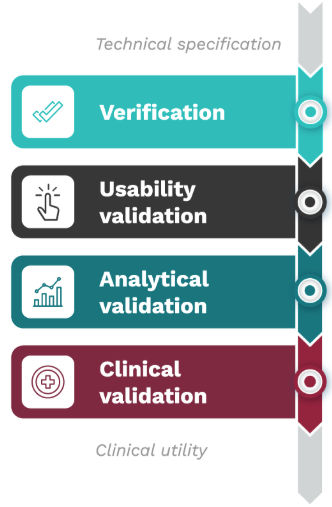
Regulatory acceptance of digital biomarkers depends on demonstrating that they are fit for purpose, including verification of device performance, analytical validation of signal reliability, and clinical validation of endpoint relevance.
Frameworks such as V3 and V3+ developed by the Digital Medicine (DiMe) Society have established expectations for evaluating digital measures, while regulatory guidance continues to emphasize validation, usability, and data integrity.
Beyond regulatory requirements, sponsors must also consider long-term value:
Can digital endpoints evolve from exploratory to primary endpoints?
Does the data support dose-response analysis or label expansion?
Can insights be reused across future studies or development programs?
While digital biomarkers are often introduced as exploratory endpoints, thoughtfully designed measurement strategies can generate evidence that extends beyond a single trial, helping justify investment and inform future development.
Learn more about Implementing Digital Endpoints in CNS Clinical Trials in Koneksa’s latest white paper.
5. Can Digital Measurement Integrate Operationally into Clinical Trials?
Even the most scientifically rigorous digital biomarker strategy can fail if it is not operationally feasible. Successful implementation requires seamless integration into clinical trial workflows, including device provisioning, participant onboarding, adherence monitoring, and technical support. Just as importantly, digital data must integrate with existing clinical systems without introducing additional burden on sites or participants
Reviewing real-world implementation experience and case studies can provide valuable insight into how effectively a partner manages operational complexity at scale. Operational feasibility also directly impacts cost, as continuous monitoring introduces additional infrastructure and analytics requirements.
Common Mistakes Sponsors Make When Selecting a Digital Biomarkers Partner
As adoption increases, several common pitfalls have emerged:
Choosing based on technology rather than measurement expertise
Collecting excessive data without a clear clinical hypothesis
Underestimating validation requirements
Overlooking operational complexity in decentralized trials
Failing to plan for long-term data reuse and value generation
Avoiding these mistakes can significantly improve the likelihood of generating meaningful, decision-ready evidence.
Turning Digital Data into Clinical Insight
The promise of digital biomarkers lies not in the volume of data collected, but in the ability to translate that data into clinically interpretable evidence.
Achieving this requires a coordinated approach that integrates measurement strategy, multi-modal data integration, advanced analytics, validation rigor, and operational scalability. Each component plays a critical role in ensuring that digital signals are not only detectable, but meaningful and actionable.
As the field continues to evolve, organizations that treat digital measurement as a scientific discipline, rather than simply a data collection exercise, will be best positioned to succeed.
Explore how a thoughtful measurement strategy can strengthen your digital biomarker programs. Contact Koneksa to discuss your clinical development needs.
Frequently Asked Questions (FAQs)
What are digital biomarkers in clinical trials?
Digital biomarkers are objective, quantifiable measures of health and disease derived from digital health technologies such as wearable sensors, mobile applications, and connected devices. In clinical trials, they enable continuous or near-continuous data collection on patient function, behavior, and physiology outside traditional clinic visits(11). Common examples include accelerometer-derived physical activity measures, gait analysis metrics, heart rate variability parameters, and app-based cognitive assessments.
Why are digital biomarkers important in decentralized trials?
Decentralized and hybrid trial designs depend on the ability to collect reliable clinical data remotely. Digital biomarkers capture high-frequency, objective data from participants in home environments, reducing the burden of site visits while maintaining data quality. The FDA’s 2023 final guidance on Digital Health Technologies (DHTs) specifically addresses how these technologies can support remote data acquisition, providing a regulatory framework for digital measurement in decentralized settings.
What capabilities should a digital biomarker partner provide?
A strong partner should provide end-to-end capabilities across the measurement lifecycle: measurement strategy and endpoint design; device selection and multimodal data integration; signal processing and statistical interpretation; validation aligned with frameworks such as V3/V3+; regulatory-grade evidence generation; and operational support for integrating digital measurement into clinical trial workflows.