

Learn how clinicians and 20+ people living with Parkinson’s ranked the disease impacts that matter most, shaping a digital instrument built around patient priorities rather than sensor capability.
Learn how clinicians and 20+ people living with Parkinson’s ranked the disease impacts that matter most, shaping a digital instrument built around patient priorities rather than sensor capability.
This pre-print examines ALSFRS-R subdomains in Amyotrophic Lateral Sclerosis (ALS) clinical studies, finding that fine and gross motor subdomains may be more sensitive to disease progression and presenting a novel non-linear method for defining fast and slow progressors.

Compare how in-clinic, burst, and weekly at-home assessment schedules change the sample size a Parkinson’s disease-modifying therapy trial needs to detect an effect.
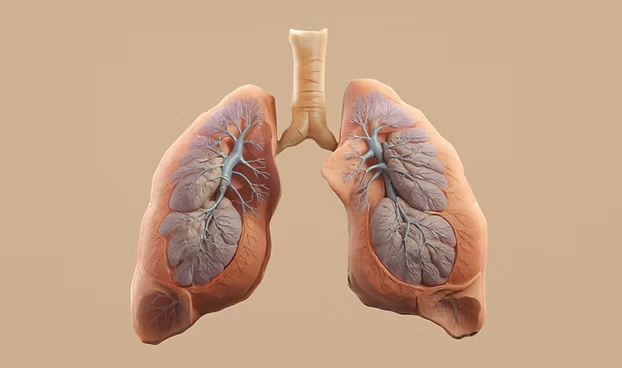
See what 3,024 expected pulmonary function tests across three asthma studies reveal about whether patients reliably complete twice-daily spirometry at home.

See how patients and clinicians shaped a composite cardiac biomarker concept for Fabry disease, combining wearables, ECG, diaries, and PROs into one measurement model.

Which finger tapping features actually track Parkinson’s symptoms? Koneksa tested six candidates against mPower study data to find out.
Find out what sponsors need to plan for when designing Bring Your Own Device (BYOD) clinical studies, capturing more representative, free-living participant data without the biases of single-timepoint clinic visits.
Explore why inconsistent definitions of adherence across biometric monitoring technology studies make it harder to trust clinical trial data, and what standardized reporting could change.
See why cat-allergic asthmatics who live with a cat needed significantly more medication, long-acting beta agonists, and high-potency corticosteroids, to achieve asthma control comparable to those without a cat at home.
Learn why wearable remote monitoring of pulmonary function, oxygen saturation, and exercise challenge tests could close a critical gap in understanding COVID-19’s long-term impact on lung function.
See why the biggest barrier to home-based clinical monitoring is no longer device availability, but integrating multimodal biometric monitoring technologies into composite, fit-for-purpose digital measures.
See how biometric monitoring technologies in oncology have evolved from early activity tracking to today’s continuous monitoring approaches, and where the field is headed next.
Explore the EVIDENCE checklist, a multidisciplinary reporting standard designed to bring consistency and rigor to studies evaluating connected sensor technologies and digital measurement products.
Learn how applying the FDA’s biomarker qualification evidentiary criteria to remote cardiac safety monitoring could help sponsors detect cardiovascular liabilities earlier, before they become costly drug development attrition events.
Explore how two decades of laboratory biomarker validation experience is being applied to biometric monitoring technologies, offering a faster, more defensible path to fit-for-purpose digital biomarker qualification.




© 2026 Koneksa Health. All Rights Reserved.